The National Archives Organizes Two Lectures on the Emirates Library and Ways to Access its Collections
Concurrently with the Reading Month
The National Archives Organizes Two Lectures on the Emirates Library and Ways to Access its Collections
Within the series of lectures and activities that the National Archives holds in the Reading Month, the Emirates Library at the National Archives organized two virtual lectures, the first lecture is entitled “Emirates Library, A Resort for Knowledge Seekers”, and the second lecture is entitled “The Electronic Catalog of the Emirates Library”. Both lectures aimed at strengthening the links between the Emirates Library and readers and facilitating access to its holdings to benefit from its collections, resources and references specialized in the history of the UAE and the Arabian Peninsula. Subsequently, the Emirates Library adopts the same goals of the National Archives which documents the memory of the nation for the generations to come.
The first lecture was delivered virtually by Mrs. Sharifa Al Fahim, Head of the Emirates Library Section at the National Archives. She spoke about the importance of the Reading Month and pointed to the significance of its slogan this year (My Family Reads), which emphasizes the role of reading in building people over the course of their lifetime. She emphasized that the Emirates Library, as it celebrates the Reading Month, exerts all possible efforts to enable readers and researchers to access its collections and provide them with its services throughout the year.
Then, she reviewed the history of the Emirates Library, which was established in 1968, in the same year as the National Archives upon the directives of the Founder and Builder Sheikh Zayed Bin Sultan Al Nahyan. Next, she introduced the services and facilities which the library offers such as allowing access to its paper and electronic resources, photocopying and circulation services and the model reading hall designed in accordance with international standards with open shelving system, a number of modern computers, special researcher cabins and Wi-Fi service.
The lecture focused on the holdings of the Emirates Library, which include thousands of distinctive paper and electronic resources, university references and dissertations, rare books, Arab and foreign periodicals. It also contains a wealth of specialized books dealing with many aspects of the UAE, topics related to the GCC states and a large number of books in all fields in both Arabic and English, in addition to items in other languages including French, German, Persian, Dutch and Portuguese.
The second lecture was delivered by Omar Hammadneh, librarian, who talked about the Emirates Library electronic catalog and methods for searching by book title, author name, series, or ISBN. He said that researchers can access the library catalog on the National Archives’ website and submit their requests electronically. He also mentioned that the Emirates Library has been providing its services electronically to many researchers in the UAE and abroad.
He explained that the search box at the top of the Emirates Library Catalog enables its visitors to look for the following categories of information: Articles About the UAE, Subject Guides, Liwa Journal Index ‘the National Archives’ scientific journal’, E-Resources, Rare Books and Napoleon Collection Online.
Both lecturers answered a number of questions about ways of extending circulation periods and other questions.
The National Archives launched an awareness program to educate its employees on the best methods to maintain good health and physical fitness
Marking the UAE National Sports Day,
The National Archives launched an awareness program to educate its employees on the best methods to maintain good health and physical fitness, as part of the UAE National Sports Day celebration activities. The program included a lecture entitled "Triangles of Life on the Importance of Sports, balanced diet and good Nutrition" in line with the National Archives' interest in its societal responsibility to its employees, and as part of its annual celebration of the UAE national Sports Day; a chance which the National Archives takes to advocate sports and shed light on its importance as a way of life as well as a physical activity for its significant health benefits.
In her presentation of the lecture, Mrs. Mariam Al-Murri, Chief Corporate Communication Officer at the National Archives, stressed the National Archives’ keenness to annually celebrate the UAE National Sports Day, and quoted the words of His Highness Sheikh Mohammed bin Rashid Al Maktoum, the UAE Vice President, Prime Minister, and Ruler of Dubai: “Sports refreshes the memory, strengthens the body, and relieves life burdens".
In his interactive virtual lecture, Dr. Nasser Salem Al Ameri praised and commended the wise leadership's efforts, and interest in the health and fitness of the UAE people and residents, as they facilitated access to well-equipped sports facilities across the UAE. He thanked the National Archives for taking the National Sports Day celebration chance to educate its employees on how to maintain their fitness and good health.
The lecturer reviewed a number of triangles starting with the human being as an equilateral triangle, where equal attention and focus should be given to his body, soul and mind, stressing that those three must be equal in a productive person. He also discussed the causes for wrinkles, osteoporosis, weight gain, heart disease and diabetes through the second triangle which title questioned: "What happens as one grows older? ". He explained that the appearance of these changes or the development of such diseases among people vary from one person to another, and to avoid or prevent them, one must adhere to practicing sports, at least walking which is the simplest of all sports.
The lecturer stressed the importance of following the teachings and guidance of Prophet Mohammed (PBUH) relating to balanced diet and good nutrition as the main principles for good health as expressed and emphasized in his words: “Eating less is the best adopted preventative method or habit against sickness and disease. A few bites or mouthfuls should suffice to sustain the sons of Adam and satisfy their hunger, should they- upon temptation- wish for more, it should be according to equal thirds or shares for their food, drink and breath". Then, Dr. Naser moved to the triangle of fasting, sports and nutrition, indicating the importance of fasting for the body, provided that it obtains adequate amount of food, drink and practices sports, at the right time; either before having breakfast or three hours after it.
The lecture tackled the basic nutrition components, and the needed calories for human body. The lecturer stressed the importance of practicing sports for women and elaborated on the Women, Sports and Society triangle, as he tackled the role of sports in treating and relieving psychological stresses. In the last triangle he discussed the proper and improper exercising methods.
The National Archives also launched a one week sports competition under the slogan "The Challenge 2021", explained its terms and conditions to its employees, and encouraged them to participate through allocating valuable prizes for winners.
The National Archives:
The National Archives of the UAE was initially established in 1968 under the Ministry of Presidential Affairs, upon directives from the late Sheikh Zayed bin Sultan Al Nahyan, with the aim of collecting and documenting material on the history and heritage of the United Arab Emirates and the Gulf region.
Forty years after its establishment, His Highness Sheikh Khalifa bin Zayed Al Nahyan, President of the UAE issued Federal Law No. (7) for 2008 upon which it became the "National Center for Documentation and Research", entrusted with organizing the UAE government entities' archives. Later, His Highness issued Federal Law No. (1) of 2014 according to which its name changed to be the "National Archives".
The National Archives Opens a New Channel That Makes Its Publications Accessible to People With Visual Impairment
Providing an Advanced Device That Enables the Reading of The Memory of The Nation in Braille
The National Archives Opens a New Channel That Makes Its Publications Accessible to People With Visual Impairment
As the National Archives continues to care for people with visual impairment, it added to its holdings a braille-reading device, named BRAILLENOTE TOUCH PLUS, which enables this segment of society to access and read its publications.
His Excellency Dr. Abdulla Alraisi, Director General of the National Archives emphasized that this care falls within the framework of the National Archive's societal and humanitarian responsibility towards people with visual impairment and providing them with important chapters of the UAE's deep-rooted history and cultural heritage to strengthen their sense of belonging to the homeland and loyalty to its wise leadership.
About this device, His Excellency Abdulla Majed Al Ali, Executive Director of the National Archives, said: “This device constitutes a part of an integrated system, by which the National Archives aims to provide access to its national publications through all means. To benefit people with visual impairment, the National Archives has provided these publications in paper form and in audio books, as well as making them available on smart applications. This comes within its tireless efforts to reach all segments of readers. As for the Braille reading device that has been recently acquired, the National Archives opens a new channel for people with visual impairment by giving them access to its publications in Braille, a tactile reading and writing system. This modern technical device instantly converts texts written in a specific format into embossed Braille letters, through which the National Archives ensures the provision of its national publications to this segment of society.”
It is worth noting that the device, which is similar in design to traditional tablets, can be loaded with the material in WORD files, but in DOC format, which it then translates instantly into Braille letters readable for the visually impaired. The National Archives has allocated a special suitable place for device users in the Customer Happiness Hall at its headquarters; thus, they are able to use it easily to read the downloaded contents in Braille. The National Archives will spare no efforts to optimally take advantage of this device by using it in the training courses and reading workshops which it organizes for people with visual impairment in book fairs and in other venues.
It should be noted that a few months ago, the National Archives, in cooperation with the Zayed Higher Organization for People of Determination, launched its book (Zayed: From Challenges to Union) printed in Braille to enable this segment of society to read chapters from the rich record of the founding leader Sheikh Zayed Bin Sultan Al Nahyan’s achievements.
Prior to this book, which has hundreds of pages, the National Archives had also printed three educational booklets in Braille, namely: “Zayed: From Challenges to Union”, “Khalifa: A Journey to the Future” and “Qasr Al Hosn, 1795-1966”.
The National Archives collaborates with official authorities concerned with people with visual impairment in several areas such as organizing lectures with patriotic content and participating in major events of interest to them.
The National Archives
The National Archives of the Ministry of Presidential Affairs was first established in 1968 upon the directives of the late Sheikh Zayed Bin Sultan Al Nahyan, with the aim of collecting documents and information relating to the history and heritage of the United Arab Emirates and the Gulf region. Forty years later, HH Sheikh Khalifa Bin Zayed Al Nahyan, the UAE President, issued Federal Law No. (7) of 2008 changing its name to the National Center for Documentation and Research (NCDR), and assigning it to organize the archives of the various UAE government entities. Finally, HH Sheikh Khalifa Bin Zayed Al Nahyan issued Federal Law No. (1) of 2014, renaming it the National Archives.
.
The National Archives receives the Month of Reading with a program full of reading events and activities
Including more than 90 events in addition to the Emirates Library’s rich program
The National Archives receives the Month of Reading with a program full of reading events and activities
The National Archives starts the reading Month of March that is celebrated this year under the slogan of “My Family Reads" with several national lectures and readings of its publications pertaining to the UAE history and heritage. The National Archives seizes this opportunity to conduct reading events and activities given its belief that reading is the essential pillar of nations development.
On this occasion, H.E. Abdulla Mohamed Alraisi, Director General of the National Archives, said “The National Archives devotes attention to reading due to its belief that reading is food for thought; it is the foundation for understanding and culture, the introduction to all sciences and the cornerstone of the knowledge-based civilizations. It also believes that reading is the primary source of employees’ qualification and happiness. As they acquire knowledge through serious reading their productivity increases. In fact, reading the Memory of the Nation publications fosters awareness and enhances loyalty and belonging to the homeland”.
H.E. Abdulla Majid Al Ali, National Archives Executive Director, said “It is true that we celebrate the Month of Reading in March; however, all months and days should be real occasions for reading. Since the Month of Reading for this year is celebrated under the slogan of “My Family Reads”, we will designate events at the National Archives to ensure that books are available for families to promote serious and fruitful reading among the society members”.
He added: “The National Archives participates in the Month of Reading with several initiatives that contribute to the achievement of the targeted objectives of this month. We have set an intensive program for reading-related events and activities that are accessible to all society segments. The program of this month includes several lectures, reading workshops, and others to provide researchers, academics and students with easy access to documented information on the UAE history and bring them closer to the National Archives’ publications which document and preserve the memory of the nation for the next generations.”
It is worth mentioning that the National Archives starts the Month of Reading with a number of reading workshops and national lectures delivered through interactive technologies in an effort to adhere to the precautionary measures to curb the spread of COVID-19. The most important lectures delivered on March 1st, include “Identity, Loyalty and Belonging: Key National Values” and “Genealogy”.
The National Archives is conducting more than 90 reading events on the UAE ancient history and biographies of the leaders whose great achievements are recognized worldwide. There is also a large number of reading workshops that are based on the National Archives publications such as Zayed, 100 Stories, Khalifa A Journey Into the Future book, Zayed From Challenges to Union, The Two Hero Leaders, and Watani Al Emarat which is an educational booklet, in addition to the March Game,
Besides, there are many national lectures namely, The Emirati San’a (Etiquette), The 100th Anniversary of the UAE and Zayed, Quotes and Lessons.
During the Month of Reading, the National Archives will have a remarkable activity which engages students in evaluating the National Identity project, which is a national project designed by the NA pursuant to its role in national education and upbringing.
The National Archives will take its audience in virtual tours of the Emirates Library, Customer Happiness Hall and Sheikh Zayed Bin Sultan Hall. These facilities are replete with historical documents, documentary films, the National Archives’ publications and historical records of the UAE.
Moreover, the Emirates Library has prepared a varied and wide program on how to search for and facilitate access to information. This program is beneficial for the National Archives’ internal and external readership.
The National Archives educates its employees on “Multilingualism and human languages mapping”
The National Archives educates its employees on "Multilingualism and human languages mapping"
The National Archives organized a virtual educational lecture entitled "Multilingualism and Human Languages Mapping ", in strict adherence to adopted precautionary measures to counter and contain Corona-virus. The virtual lecture was delivered by Dr. Saddik Gouhar, Translation expert at the National Archives, and it depicted the prominent role of the UAE in preserving the Arabic language as a national language and an identity symbol. Dr. Saddik praised the UAE's keen interest to promote, and preserve the Arabic language, and enhance its global position, while concurrently using diverse other languages since multilingualism has a clear and significant impact on tolerance promotion among individuals and society.
The lecturer stressed the importance of multilingualism as an essential element of civilized communication, coexistence and tolerance between the various people of the world indicating that all this has been successfully achieved in the UAE which hosts communities of more than two hundred various world nationalities, each of which use their mother tongue to communicate. The UAE usefully employs the different cultures in the field of sustainable development for people's welfare, development and peace. The lecturer reviewed the various languages map at present, indicating that thousands of languages are physically in circulation but cannot be specifically calculated. He then elaborated on the various human languages mapping and political hegemony, and discussed at length the conflict and clash between the different languages in Africa. Dr. Gouhar said that the place most renowned for its language linguistic diversity in the world is the southern African Sahara, where thousands of oral and written languages are in use, a factor which colonial powers utilized to increase differences and gaps in order to divide and control. The African people most likely depended on their memory for recording and registering events, accordingly, oral languages spread, but the colonial languages remained dominant since they allowed local elites to protect their interests and maintain their gains.
The lecturer gave a comprehensive presentation on local languages and multilingualism in the Republic of South Africa, highlighting the conflict and clash there between the Afrikaans and English languages, and the attempts to marginalize the Afrikaans language. Dr. Gouhar also shed light on the linguistic scene in the post-racial era.
The lecture also depicted “the dominance of the colonial language on the African scene in the post-colonial era”, the primary and secondary local languages, and stressed that the more indigenous languages and local dialects, the more powerful, widespread and dominant the colonial language became, and continued as such until it became deep-rooted in the African land after most African countries became independent in the 1960s and managed to coexist with the main primary or central native languages until colonial languages gradually became a first or second language, and naturally, seekers of distinguished jobs or a prominent positions were keen to learn the dominant language, which proved detrimental to the public interest at the expense of personal interests and gains. In conclusion, the lecture pointed out that some emerging countries tried to issue linguistic practices legislations, and struggled to adopt and use a single official language, as did the countries that obtained their independence, based on the fact that language is an expression of the general spirit and common identity, and is an embodiment of nationalism, and a communication tool that serves the state and its economy.
The National Archives impresses visitors with historical documents that open a window onto the UAE history
The National Archives impresses visitors with historical documents that open a window onto the UAE history
The National Archives’ Memory of Nation platform at Sheikh Zayed Festival showcases numerous historical documents, the oldest of which dates back to the 17th century. The National Archives has offered festival visitors, who are interested in these documents because of their great significance in the UAE’s history, the opportunity to view such invaluable holdings using amazing techniques successfully.
Old historical documents were displayed at the Memory of Nation platform due to their significance in writing history and their role in fostering and maintaining the national identity.
Among the most significant historical documents displayed at the platform are: the Preliminary Agreement between Sheikh Shakhbut Bin Dhiab, Ruler of Abu Dhabi, and the British government in 1820, a letter from Sheikh Shakhbut Bin Dhiab Al Falahi in Abu Dhabi to the British political agent in 1821, and an acknowledgment from Sheikh Hamdan Bin Zayed the First, Ruler of Abu Dhabi, to the British government regarding an oil exploration concession in May 1922, in addition to outline drawings of Kalba Fort, which fell under the Portuguese control in 1624, a Portuguese fort built in Khor Fakkan in 1620 and Al Bidiya Fort, which was seized by Portuguese in 1623. They also include many other old historical documents bearing witness to history and events and containing ample information which unveil past events, so they captured the attention of the festival visitors that they took pictures of them.
The National Archives is interested in displaying historical documents at the platform because of their importance to researchers, academics and to those interested in the UAE’s history. It is worth noting that the National Archives’ holdings include historical documents pertaining to the UAE history as well as the Gulf region as researchers take advantage of them to learn about the ancestors’ past and the ancient civilizations.
The National Archives maintains millions of archival materials and historical documents compiled from all over the world, and it continues to collect important documents related to the UAE in order to achieve its main objective of building a modern national archive. It also uses the most recent technologies in preserving and providing accessibility to its unique and important holdings and historical documents, which contain historical information on the most significant events in the UAE and the Gulf region and key information about the UAE areas which witnessed major events and changes. Besides, the documents contain aspects of the biographies of the great leaders and sincere citizens and they highlight the UAE’s unique union experience.
The National Archives maintains diverse historical documents including written correspondences and agreements as well as thousands of photos, maps and multimedia to aid decision makers, and it makes them accessible to researchers to find out about the region’s history and to young generations to draw lessons from them.
The National Archives employs its documentary asset in its historical publications and its photographs and multimedia in the exhibitions it organizes, mainly the ‘Memory of Nation’ platform with which it has participated in Sheikh Zayed Festival for eight years.
The National Archives
The National Archives of the Ministry of Presidential Affairs was first established in 1968 upon the directives of the late Sheikh Zayed Bin Sultan Al Nahyan, with the aim of collecting documents and information relating to the history and heritage of the United Arab Emirates and the Gulf region. Forty years later, HH Sheikh Khalifa Bin Zayed Al Nahyan, the UAE President, issued Federal Law No. (7) of 2008 changing its name to the National Center for Documentation and Research (NCDR), and assigning it to organize the archives of the various UAE government entities. Finally, HH Sheikh Khalifa Bin Zayed Al Nahyan issued Federal Law No. (1) of 2014, renaming it the National Archives.
.
The National Archives- in cooperation with the Ministry of “Education”- supplements the national education curricula with historical documentary films
The National Archives- in cooperation with the Ministry of "Education"- supplements the national education curricula with historical documentary films promoting loyalty and belonging to the UAE
As part of the ongoing cooperation and strategic partnership between the National Archives and the Ministry of Education in the United Arab Emirates, the National Archives supplemented state schools social studies and civic education curricula with short national historical documentary films that support the curriculum and further explain its details, to enhance students' visual and mental historical memory with national values and principles, thus enhancing their loyalty and belonging, and establishing their national identity.
The National Archives provided the Ministry of Education access to ten documentary films from the "Memory of the Nation", which were included in "Al Diwan" platform. The Ministry also included them in school-books and provided access to these historical documentary films through a scan code for each, so students can watch them on their mobile devices.
The Ministry of Education has supported its national curricula with these films, which the National Archives has produced in line with its national responsibility, and classified them according to the consistency and conformity of their content with its educational subjects or material.
The diverse documentary films' topics enrich school curricula, as they depict aspects of the glorious biography of the late Sheikh Zayed bin Sultan Al Nahyan, and his brothers the founding fathers of the UAE, and deal with its history and civilization.
These films are well received by students because they support in an audio-visual form and an interesting cinematic production, the theoretical knowledge and information they received through their books.
About this mutual cooperation, His Excellency Abdullah Majed Al Ali, Executive Director of the National Archives said: The cooperation between the National Archives and the Ministry of Education takes strategic dimensions which allow the National Archives to play its role in developing and enhancing students' knowledge in order to build and shape their personality as needed by the nation whether at present or in future. He added that the National Archives is a strong supporter for UAE educational projects and systems, this stems from its belief in its documentary mission and its societal role, noting that the National Archives various important projects and initiatives in collaboration with the Ministry of Education have qualified it to win the Khalifa Award for Education for the education supporting institutions category.
His Excellency also stressed that the close cooperation between the National Archives and the Ministry of Education is achieving the targeted objectives aiming at providing sound civic education and historical awareness of the homeland thus establishing the national identity of UAE students who constitute the backbone, and pillar supporting the UAE future,.
The cooperation between the National Archives and the Ministry of Education resulted in several programs, projects and initiatives, since the National Archives is the targeted destination for history and heritage research students of all ages, where they find the most important, reliable and authentic historical documents, references and sources, whether in the traditional hardcopy or in digital form.
The National Archives- concurrently with organizing students school trips to the its headquarters- launched its educational national awareness program: “My Nation, My Identity, ..My loyalty and belonging”, which instills in young generations the supreme values of loyalty and belonging and reinforces principles of national identity and good citizenship for a better and promising UAE future.
In cooperation with the Ministry of Education, the National Archives annually holds the "Teachers Forum" which has become a cultural event aiming to support the vision of the United Arab Emirates through instilling national identity in UAE people, and promoting the values of loyalty and belonging to the homeland and its wise leadership. The forum aims to bridge gaps between teachers, students, and parents by enhancing teachers' knowledge of the history and heritage of the United Arab Emirates, and introducing them to Emirati customs, traditions that bring them closer to students. Moreover, the Ministry employs the National Archives' efforts and national experiences and expertise in preparing history and civic education curricula.
Among the ongoing projects between the National Archives and the Ministry of Education is the Student Historians Club, which aims to develop students' awareness of their homeland, its history, heritage and achievements, and to enhance their educational process as this project constitutes a link that bridges the gap between students theoretical education received at school and its practical application.
Among the joint initiatives between the two parties is "My Archive.. My Future" stemming from "Watheq" national campaign which aims to educate school students and raise their awareness about the importance of documenting personal records as part of the future memory of the nation. As well as the national educational initiative "Zayed 100 Stories", which resulted in encouraging and motivating students to prepare 100 stories about the Founding Leader, the late Sheikh Zayed bin Sultan Al Nahyan from the memory of the nation, through their readings of his glorious biography.
"Our Inspirational Stories" initiative has directed students to write about carefully considered and targeted national historical programs that contribute to the development of society, highlight humanitarian and community projects and initiatives, spread hope, instill values of benevolence and giving, enhance positivity and optimism, and improve the quality of life in the Emirati society.
The initiatives of "Zayed.. 100 Stories", "Our Inspirational Stories" and the "Writers of the UAE Fiftieth Anniversary" constitute a golden triangle for students' creativity. The National Archives has evaluated the students participating works in the latter initiative, and anticipated a bright future that awaits these future generations. That initiative was designed to prepare a creative generation of students, to sponsor, take care of them, and enhance their knowledge and writing skills, to eventually lead them to cultural distinction.
Perhaps the most prominent stage of the two institutions' cooperation is the series of "Reading through the Memory of the Nation" projects that were launched concurrently with the "Year of Zayed" and included a number of initiatives aiming to benefit all UAE school students, and focusing on the eternal legacy of the late Sheikh Zayed bin Sultan Al Nahyan, his achievements, wisdom, efforts and endeavors for the development of mankind, and his ahead of his time vision for national sustainability. this series includes:
- The initiative to provide one hundred school libraries and enrich them with historic and national books.
- The initiative to provide a hundred other schools with the words and quotes of the wise Arab Leader, Sheikh Zayed.
- The initiative to publish one million of the following educational booklets: “Khalifa… A Journey into the Future” and the book “Zayed, From Challenges To Union ", and " Qasr Al Hosn: The History of the Rulers of Abu Dhabi ".
It is noteworthy that the cooperation between the two parties began with school trips to the National Archives headquarters (previously called the "Center for Documentation and Research"), and later launched the "Young Historian Award", in 2009, with the aim of enhancing the values of loyalty, belonging, national identity, and developing historical awareness of generations of students, which helped them to develop their critical and analytic skills, their innovative thinking and expression, through employing innovative research approaches, and encouraged their research on the UAE history and heritage and their preservation. This award, which will soon come to its Twelfth edition has achieved its targeted objectives; as it attracted and encouraged a large number of students to research on the various eras of the UAE history.
The National Archives:
The National Archives of the United Arab Emirates was established under the Ministry of Presidential Affairs in 1968, based on the directives of the late Sheikh Zayed bin Sultan Al Nahyan, with the aim of collecting and documenting material relating to the history and heritage of the United Arab Emirates and the Gulf region. Forty years after its establishment, His Highness Sheikh Khalifa bin Zayed Al Nahyan issued Federal Law No. (7) for the year 2008 to change its name to be the National Center for Documentation and Research, entrusted with the task of organizing government entities archives in the United Arab Emirates, then a later order issued by His Highness Sheikh Khalifa bin Zayed Al Nahyan, President of the UAE to change its name from the (National Center for Documentation and Research) to be the (National Archives) in accordance with Federal Law No. (1) of 2014.
The National Archives Supports the Students of “Records Management and Archival Science” with Specialized Lectures
In Collaboration with the Sorbonne - Abu Dhabi
The National Archives Supports the Students of “Records Management and Archival Science” with Specialized Lectures
The National Archives held a series of specialized lectures about methods of preserving, restoring and digitizing historical films and photographs for the students enrolled in the Bachelor’s degree in “Records Management and Archival Science” at the Sorbonne University - Abu Dhabi.
The National Archives held these lectures in collaboration with the Sorbonne University – Abu Dhabi, with the aim of integrating students’ theoretical studies with field and practical practices and help them become fully acquainted with the scientific and practical skills in the field of preserving historical films and photographs of our present time which is witnessing rapid technological changes.
The National Archives directs attention to the students enrolled in the BA degree in “Records Management and Archival Science” at the Sorbonne University - Abu Dhabi because it is the university’s partner in this undergraduate program and looks forward to continuing cooperation with it to launch higher academic degrees in the same specialty this year.
Delivered virtually through interactive technologies in application of the precautionary measures to curb the global spread of Covid-19, the lectures enriched the students' knowledge with detailed information in the field of preservation, restoration and digitization of historical photographs and the old multimedia in the National Archives and other institutions.
The specialized lectures, given by Abdullah Al-Bastaki, Digital Archives Specialist at the National Archives, included seven themes. It dealt with photographic collections, animated films and videotapes with respect to their types and sizes and the processes and guidelines followed in digitizing documents in the National Archives and other institutions. They also shed light on the equipment for digitization and preservation and the methods of using them. Moreover, the lectures explained the methods of managing, acquiring and organizing collections and setting priorities in digitization and methods of conservation for each collection and the re-storing process in the National Archives, in addition to methods of handling fragile elements including photo albums and controlling temperature and humidity.
In the field of building expertise, the lectures focused on how to develop best archival practices based on the specific needs of archives and explained the different professional paths in preservation and restoration and the importance of providing professional advice.
The two day lecture series, held by the National Archives, were attended by more than 40 students, who actively interacted with the lecturer asking various questions and enquiring about details, which indicated their interest in this important aspect of archival work.
It is noteworthy that the specialized undergraduate program which was launched by the National Archives in collaboration with the Sorbonne University - Abu Dhabi in 2019, aims to qualify students in the field of documentation and archiving and to keep pace with the requirements of the present time and the labor market in light of the general awareness of archives’ importance in all official bodies and state institutions. The program looks forward to providing students with the highest academic levels in “Records Management and Archival Science” within a professional context.
The scientific, professional and academic integration that connects the National Archives with the established Sorbonne University - Abu Dhabi is very important in developing all aspects related to the specialized study and scientific research in the field of “Records Management and Archival Science”. Moreover, it contributes to preparing a generation that is well aware of archives’ significance as they represent the memory of the nation and form the mainstay of work and decision-making in any professional institution.
The National Archives
The National Archives of the Ministry of Presidential Affairs was first established in 1968 upon the directives of the late Sheikh Zayed Bin Sultan Al Nahyan, with the aim of collecting documents and information relating to the history and heritage of the United Arab Emirates and the Gulf region. Forty years later, HH Sheikh Khalifa Bin Zayed Al Nahyan, the UAE President, issued Federal Law No. (7) of 2008 changing its name to the National Center for Documentation and Research (NCDR), and assigning it to organize the archives of the various UAE government entities. Finally, HH Sheikh Khalifa Bin Zayed Al Nahyan issued Federal Law No. (1) of 2014, renaming it the National Archives.
.
The National Archives organizes a training course on best practices in government entities’ document inventory
The National Archives organizes a training course on best practices in government entities’ document inventory
Having signed a memorandum of understanding with Ministry of Justice recently, the National Archives held a training course entitled Government Entities’ Documents Inventory for the ministry’s employees. The MoU aims to enhance collaboration in areas which support both parties’ missions and work jointly to organize the ministry’s archives. The training course represents the National Archives’ contribution to setting up a model integrated system for the Ministry of Justice both paper and electronic archives as well as applying an integrated document management policy, enhancing skills in paper and electronic document conservation and developing qualified archive cadres.
The training course which was delivered remotely by the archiving expert, Ahmed Mujib, dealt with the archive document, the process of inventorying documents produced and received in a government entity, determining their conservation places and preparing the relevant lists. He pointed out that this procedure is conducted regularly at the end of each year to identify the numbers, types and conservation locations of document.
The training course defined the objective of the document inventory process in compliance with the legal requirements set by the Federal Law on the National Archives No. (7) of 2008, amended by Law No. (1) of 2014 and its executive regulations. This process seeks to inventorying files and documents in the sites of the government entities, preparing lists of files in all organizational units to be able to check their integrity, and using lists to search for documents and control the process of viewing them.
The training course dealt with the articles of Law No. (1) of 2014 and its executive regulations, which dealt with organizing and conserving documents at government entities. It also reviewed pictures of scattered archives in some stores and the methods of putting files in archive boxes and placing them on shelves, in addition to pictures of the archives on shelves or in cabinets, and the sequential numbering of boxes or files regardless of their content or source.
The training course, in which a large number of employees of the Ministry of Justice and National Archives participated, also dealt with preparing for the document inventory process by identifying the required inventory locations, preparing posters to number sites, shelves and cabinets, placing posters in the appropriate spot, and then recording the inventory data. Besides, it outlined the requirements for regulating and implementing document inventory at government entities.
It is noteworthy that the National Archives has drawn up a plan to spread archival culture among government entities. Thus, it organized many awareness workshops for government entities about the work actions related to managing current and intermediate documents and organizing paper and electronic archives. Additionally, the awareness workshops dealt with many other topics such as document inventory, document and archive transfer, document destruction, document classification, preparation of filing plans, document conservation and availability, and many electronic archiving issues.
The National Archives also organizes awareness workshops for archives officials, highlighting the importance of managing files in government entities in a scientific method, in accordance with the UAE’s laws. Moreover, the National Archives’ specialized teams make field visits to organize the archives of the local government entities, and the National Archives also provides free consultations and other services to public and private entities.
The National Archives
The National Archives of the Ministry of Presidential Affairs was first established in 1968 upon the directives of the late Sheikh Zayed Bin Sultan Al Nahyan, with the aim of collecting documents and information relating to the history and heritage of the United Arab Emirates and the Gulf region. Forty years later, HH Sheikh Khalifa Bin Zayed Al Nahyan, the UAE President, issued Federal Law No. (7) of 2008 changing its name to be the National Center for Documentation and Research (NCDR), and assigning it to organize the archives of the various UAE government entities. In 2014, HH Sheikh Khalifa Bin Zayed Al Nahyan issued Federal Law No. (1) of 2014, which changed its name to the National Archives.
The National Archives organized two national lectures as part of the Human Fraternity Festival events
“The UAE, ..nation and land of Tolerance and Human Fraternity ... a bully-free world”
The National Archives organized two national lectures as part of the Human Fraternity Festival events
The National Archives organized two lectures as part of the events of the annual Human Fraternity Festival, that starts on February 4th, and is organized by the UAE Ministry of Tolerance and Coexistence. This festival comes in celebration and commemoration of the International Day of Human Fraternity declared by the United Nations, in commemoration of the signing of the Abu Dhabi Document on Human Fraternity on February 4th, 2019, which is in essence a message of love and peace from the UAE to the world.
The two virtual interactive lectures came in strict adherence to adopted precautionary measures to counter and contain the spread of Covid-19 virus: the first of which is entitled: “The UAE, ..the land of tolerance,” while the second is entitled: “Human Fraternity ... a bully-free world.”
The first lecture was delivered by the lecturer Muhammad Ismail Abdullah, Senior Educational Programs Officer at the National Archives who stressed that the UAE shall continue to spread hope and goodness, and that the 4th of February will remain an occasion which illustrates that the UAE is a global capital of tolerance that promotes coexistence, solidarity and tolerance values.
The lecturer quoted the founding leader Sheikh Zayed bin Sultan Al Nahyan's words: "Tolerance is a must, because a person is a human being in the first place, whether Muslim or non-Muslim, he is God's creation", and illustrated by speaking of tolerance in Sheikh Zayed's approach; emphasizing that he has always sought to preserve the values of Islam, making equality and tolerance a way of life, and since the establishment of the Union, he has warmly welcomed all nationalities to the UAE, which he made a land of tolerance, coexistence and love. The lecturer defined tolerance as acceptance, mercy, lenience, and kindness, he added that its linguistic connotation or terminology imply patience, forgiveness, mercy and benevolence, and that tolerance is one of the most important human values in the world.
The lecturer indicated that Islam is a religion of tolerance, honor, pride, and justice, and that religious tolerance- as opposed to intolerance- is based on accepting others and respecting their beliefs. The lecturer pointed out that the values of tolerance and love are deep rooted in the UAE society and are integral constituents of its cultural and social heritage, where people has long lived and coexisted with love, as the UAE people developed a unique social solidarity system based on social solidarity and tolerance values.
the lecturer also listed the characteristics of the Emirati society, indicating that it is one of the most successful and accomplished societies in terms of adopting, displaying and exercising the values of tolerance instilled and established by the UAE and its wise leadership. The lecturer then spoke of tolerance in the UAE constitution, and the story behind (Al-Ghaf tree) as the slogan of tolerance and the reason for choosing it.
In conclusion, the lecturer spoke about the Emirati example and model of tolerance, and the programs and tools supporting it, highlighting the positive role that the media plays in promoting tolerance in society.
As for the second lecture, "Human Fraternity ... a bully-free world", delivered by the Emirati Author Mariam Al Hammadi who stressed that the UAE will always remain a beacon that disseminates and promotes the values of tolerance and giving, and seeks to achieve the well-fare, happiness and development for all beings. She later depicted the workplace or professional bullying, and reviewed some of its forms, such as: exclusion, or isolation of the bullied employee, disregarding his/her feelings, and attaching no significance or importance to them, directing false accusations, demotion and termination, unjust evaluation, pushing him/ her to resign or leave work ... etc. The lecturer shed light on the bully deriving factors, and explained the five monkeys theory in management, then proceeded to explain the situation of bullying institutions. In conclusion, she reviewed the methods adopted to eliminate workplace bullying and deal with or treat its negative effects.
The National Archives:
The National Archives of the United Arab Emirates was established in 1968 under the Ministry of Presidential Affairs, based on the directives of the late Sheikh Zayed bin Sultan Al Nahyan, with the aim of collecting and documenting material relating to the history and heritage of the United Arab Emirates and the Gulf region. Forty years after its establishment, His Highness Sheikh Khalifa bin Zayed Al Nahyan, the UAE President issued Federal Law No. (7) for the year 2008 to change its name to be the National Center for Documentation and Research, which was entrusted with organizing the UAE government entities' archives. Later, His Highness issued his orders to change its name to be the (National Archives) in accordance with Federal Law No. (1) of 2014.
A delegation from the Ministry of Foreign Affairs and International Cooperation visited the Center for Preservation and Restoration of the National Archives and praised its crucial role in preserving the memory of the nation
A delegation from the Ministry of Foreign Affairs and International Cooperation visited the Center for Preservation and Restoration of the National Archives and praised its crucial role in preserving the memory of the nation
A delegation from the Ministry of Foreign Affairs and International Cooperation visited the Preservation and Restoration Center of the National Archives where its members explored the preservation stores keeping government entities documents, and the key archives management adopted procedures in: the government archives, the Digital archives, and the preservation and restoration sections.
The visit came as a prelude to transferring the Ministry's historical documents to the Preservation and Restoration center of the National Archives, as part of the UAE documentary material compiling.
The Ministry of Foreign Affairs and International Cooperation delegation toured the large warehouses equipped with the latest technologies, and adopting the latest and most sophisticated global practices in preserving historical documents transferred to the National Archives from various UAE government archives.
The delegation members were briefed about the role of the restoration laboratory which undertakes the restoration of frayed or worn important historical documents with great historical value to repair any damage and extend their lifespan.
The preservation and restoration center officials briefed their guests with information on the building which was established under the provisions of Federal Law No. (7) of 2008 on the National Archives, later amended by Federal Law No. (1) of 2014 with the aim of organizing the process of preserving governmental and official historical records. They indicated that the building includes 19 large stores designed to receive various government entities archives, with a storage capacity that accommodates more than 890 thousand (equivalent to over three and a half million) archives boxes.
The visiting delegation was also briefed on some techniques relating to documents digitization whether on microfilms or microfiches, on high-resolution electronic photo-copying techniques for all types of documents, on providing various research fields for those wishing to benefit from the National Archives valuable and accessible information and material preserved to serve in documenting the UAE history.
The visiting delegation also viewed the various techniques adopted for treating and restoring fragile historical documents that succumbed to damage to be utilized later after preserving and safeguarding them in specially equipped stores, and digitizing them to allow for their accessibility in a timely and user friendly manner.
At the end of the visit, the delegation members praised the great accomplishments witnessed at the National Archives Preservation and Restoration Center and its facilities, indicating that it is an important national achievement for the National Archives which contributes to preserving the memory of the nation and safeguarding it against any damage or loss. They expressed their great admiration for the adopted safety and security measures to counter any emergency or sudden disaster, and the great care and interest vested in safeguarding and preserving authentic documents and archival records, and the methods employed to ensure their easy and timely access upon need. They highly valued the adopted precautionary and preventive measures currently required to counter and contain the global outbreak of Coronavirus.
It is noteworthy that the National Archives has- for more than half a century- been collecting historical documents and preserving them for future generations to make them available to decision-makers, researchers, academics and all interested in the history and heritage of the UAE, and has allocated the preservation and restoration center building for the preservation and conservation of historical records and documents which are an irrefutable evidence of important events in the history of the Emirates.
These visits Shed light on the National Archives role in preserving the history and memory of the nation, and is a tangible reminder of the founding father and leader, the late Sheikh Zayed bin Sultan Al Nahyan who was the first to realize the importance of documents and to vest great interest in them- as duly deserved since they constitute the cultural legacy and heritage of the nation- when he issued his directives for the establishment of the National Archives in 1968 to hold and preserve, for future generations, historical records and documents that represent the memory of the nation, through their description, classification and indexing; since they are considered an important supporting pillar for national identity and values, as they include and constitute documented historical information. The National Archives is proud to disseminate culture through documented history and authentic documents presented in its various valuable publications.
The National Archives of the UAE was established under the Ministry of Presidential Affairs in 1968, upon directives of the late Sheikh Zayed bin Sultan Al Nahyan, with the aim of collecting and documenting material relating to the history and heritage of the UAE and the Gulf region. Forty years later, His Highness Sheikh Khalifa bin Zayed Al Nahyan President of the UAE, issued Federal Law No. 7 of 2008, changing it to be the National Center for Documentation and Research, entrusted with organizing government entities archives in the United Arab Emirates. Then in 2014, His Highness Sheikh Khalifa bin Zayed issued Federal Law No. (1) changing its name from (the National Center for Documentation and Research) to be (National Archives).
The Emirates Library: Serving as the Nation’s Memory and Sharing it
The Emirates Library: Serving as the Nation’s Memory and Sharing it
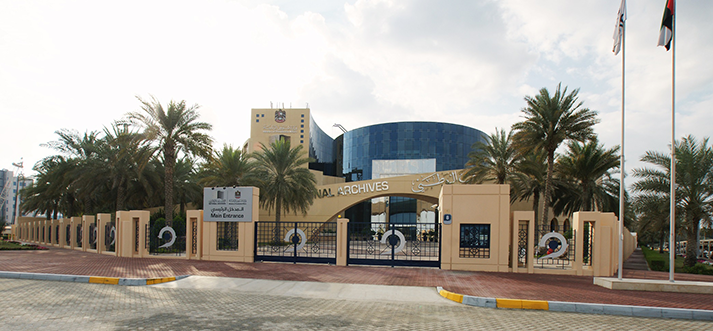
The Emirates Library, at the National Archives, is a specialized research library established in 1968. The Library provides facilities for borrowing and circulation including access to electronic resources and photocopy services in line with local and international copyright laws. The Library is focused on topics related specifically to the United Arab Emirates as well as the Gulf Region and other relevant topics. The Library utilizes the Library of Congress Classification system. In addition to its collections of print resources, the Library contains a press archive of local, Arab, and International newspapers and magazines as well as a collection of theses and dissertations.
Most of the Arabic titles the Library eagerly acquired, from the exhibition, are in line not only with the objectives of the National Archives but the requirements of academics and researchers conducting research on the history and heritage of the Emirates who patron the Library. The aim is to provide more references and resources concerning the history and heritage of the Emirates and the Gulf Region.
The Library has worked to enrich its’ holdings with the most important historical books, series, dictionaries, etc., most prominently: Dictionary of Tools in Emirati Heritage; Al Ain: City of History and Civilization; Al Dhaid City: A Reading in History and Personalities; Zayed and the Objectives of Islamic Law; Al-Sana - Timeless Values Throughout the Ages; Liwa Through History; Emirates of the Coast: Memoirs of Julian Walker. Other significant holdings include: The Arabian Gulf through the texts of Portuguese Travelers and Historians During the Era of the Great Geographical Discoveries and the Portuguese Occupation of the Gulf, in three volumes; The United Arab Emirates: Difficulties of Establishment and Construction Components; Postal Services in the Emirate of the Coast; Glimpses of the History of Health and Medical Care in the Emirate of Sharjah; Trade in the Emirates of Old. Other books deal with the history and heritage of sister countries: The Kuwaitis: History and Occupations; Times, Places, and Personalities in Bahrain, the Emirates, Saudi Arabia, Kuwait, Oman and Qatar, in two parts; The Political and Commercial History of Oman and its Foreign Relations in the Islamic Middle Ages (749-1208 AD); Historical Views of Kuwaiti Figures, in two volumes; Ascribed Inscriptions Regarding Water and Irrigation in Ancient Yemen; The Bu Saids and the Family of Saud; Andalusian History from the Islamic Conquest to the Fall of Granada.
The Library has a keen interest in encyclopedias and in linguistic and general dictionaries and it has acquired a number of these reference works, most significantly: The Large Golden Dictionary; Dictionary of the Language of the Sharia, in four volumes; A Dictionary of Famous Women; Major Encyclopedia of World-Famous Persons, in twenty-four volumes.
It is noteworthy that the Emirates Library, part of the scientific and research program of the National Archives, provides visitors with services to take benefit from its’ rich and specialized collection. This includes thousands of distinguished premium print and electronic resources, which form integrated collections of references, theses, rare books, Arab and foreign periodicals, and online subscriptions to eBooks, and various databases. The Library contains a wealth of historical books, the most important books on the UAE and topics related to the countries of the Gulf Cooperation Council. It includes biographical books, atlases (including the largest atlas in the world), dictionaries, encyclopedias, original rare books, etc. Information resources in the library are in two languages, Arabic and English, augmented by materials in other major languages such as French, German, Farsi, Dutch, and Portuguese.
The Library is preparing for the launch of its digital repository project in 2021, which represents the first of its efforts to provide access to the Library’s various digital assets relating to government publications, rare books, periodical articles, and open access resources. In addition, the Library continues to contribute to the project, “Arabic Collections Online,” available free in the form of a digital repository of rare Arabic books on the internet via the link: http://dlib.nyu.edu/aco/ .